
How to Put Together a Business Plan for Your Restaurant

How to Put Together a Business Plan for Your Restaurant


Gina Lucia

If you want to put together a business plan for your restaurant but don’t know where to start, this article is for you.
To run a successful restaurant, you need to start with a solid business plan. But developing a restaurant business plan isn’t easy. You need to bring in a lot of information to ensure the final document is complete and effective.
As a result, you may be stuck on where to start or what to include. We’re here to help. In this article, we’ll guide you through putting together a solid business plan for your restaurant.
We’ll cover:
- Why do you need a business plan for your restaurant?
- The key elements your restaurant business plan should include.
- The various formats your restaurant business plan can take.
Let’s begin by understanding why your restaurant needs a business plan in the first place.
Why do you need a restaurant business plan?
First, what is a restaurant business plan? It is a formal document in which you put everything regarding your restaurant’s concept in writing.
It details exactly:
- What your restaurant is.
- Why will it be successful?
- How it will operate.
- How will it make money?
- When you expect it to become profitable.
A business plan is standard for anyone who wants to start a new business, but it’s especially important for restaurateurs. Why? Restaurants are notorious for having a high failure rate; only 17% make it past the first year.
Going in with a solid business plan gives you a better chance of making it. Here’s why.

It helps to verify if you have a workable concept
You might have the best pizza recipe in the city, but that doesn’t mean you have a viable business. Creating a solid business plan forces you to think about what it takes to make your restaurant idea work.
Specifically, it helps you answer the following key questions:
- Does your target market actually exist? It has a section for market analysis where you research how your concept fits the customer you want to sell to. For example, a high-end fondue restaurant is a great idea, but it’s not workable if you want to sell to students because it prices them out.
- Can your business be profitable? As you develop the financial projections section in your business plan, you’ll be able to analyze if your business can turn a profit.
- Is it operationally feasible? Meaning, can the equipment, kitchen space, staffing, etc., support the dining experience you aim to deliver?
In short, a restaurant business plan allows you to plan for your restaurant. This clarity ensures you’re not doing guesswork as you start your business.
It is crucial to get outside capital
Unless you’re fully funding the restaurant with your own cash, you’ll need a bank loan or investors to open it. The first thing banks and investors will ask for is your business plan.
Banks, for one, don’t really care how great your food tastes. They care about your ability to repay the loan you’re requesting monthly (the debt service coverage ratio). You’ll be able to show them what you plan to do to have enough cash flow to cover your loan payments.
Investors, on the other hand, want to be assured that they’ll get a return on their investment. Your business plan allows you to show them that your restaurant can turn a significant profit.

It guides operations and long-term decisions
Your plan is your roadmap for:
- Marketing strategies.
- Sourcing materials.
- Staffing needs.
- Customer experience design, etc.
You can always refer to it when you need to make a decision. Suppose you run into a problem down the line, let’s say, you won an Italian Deli and two months in, lunch is slow. If you don’t have a business plan, you risk panicking and resorting to selling tacos or burgers to attract more people.
You might end up confusing your customers and ruining your brand in this way. With a business plan, you can prepare for these situations and refer to it when you’re stuck in a rut.
It exposes hidden costs
New restaurant owners often budget for food, rent, and decor, but forget hidden costs that could harm cash flow. Developing a business plan forces you to search and list things like:
- Licensing fees: Especially if you’re selling liquor.
- Waste: What happens to the food you don’t sell?
- Maintenance: For example, the costs you’ll incur if your freezer breaks down.
A business plan is so important to your restaurant. This is why putting it together requires careful thought and time. It’s not something you can rush through at the last minute.
To be able to convince lenders and guide your operations, your business plan must have some key elements. Let’s look at those elements next.

What key elements should be included in a restaurant business plan?
What should go into a good restaurant business plan? If you want to have a professional, polished plan, here are the key sections you must include in it.
Executive summary
This is the high-level overview of your restaurant concept. It includes your mission statement, startup costs, financial plan, and projections, etc. It summarizes what your restaurant is all about and why it will succeed.
Company description/business concept
Here, you describe the restaurant you want to start in detail. Basically answering this question: ‘What type of restaurant are you building, and why will people want to dine there?’ To do this, you include your business model, target audience, service style, etc.
Industry and market analysis
This is where you prove your restaurant has a place in the market by analyzing:
- Your target market and their demographics.
- Competitors.
- Your restaurant business by performing a SWOT analysis.
This section allows you to show that you’ve done your homework and you aren’t leaving things to chance.

Menu and restaurant operations plan
Investors will want to see a sample menu to know exactly what you’ll be serving. On top of that, the details on your operations, such as the management team and staffing, matter to them.
Restaurant design
If you want a physical location, you must also share how you plan to design it. You should disclose how you’ll decorate the dining area, the floor plan you’ll use, table layouts, and how you’ll match it with your menu’s design.
Restaurant marketing plan and marketing strategy
A good business plan will explain how you’ll attract customers and keep them coming back. Your marketing strategy can include your digital presence (website, online ordering, and social media), promotional events, or partnerships.
Other services
Apart from dine-in, what other services will you offer to cater to different customer preferences? Today, customers expect takeout and delivery. You can also offer catering for added revenue. Here’s where you explain all this.
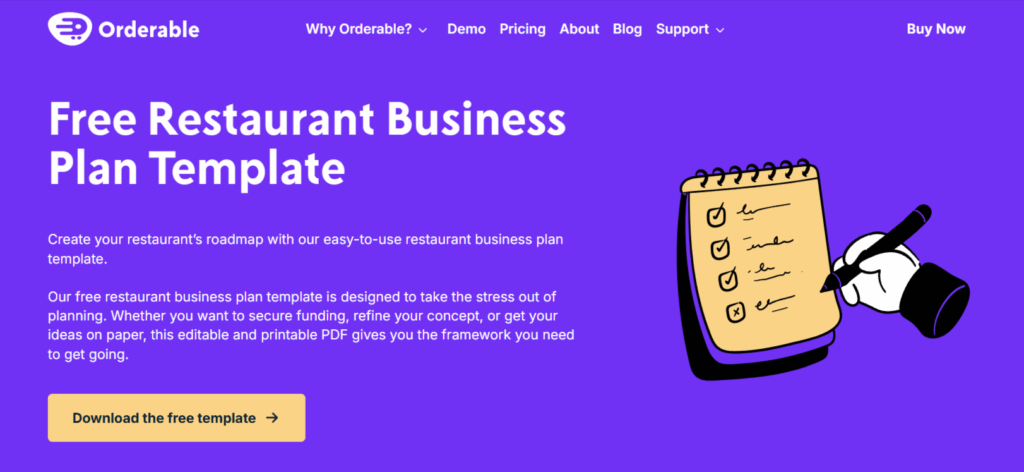
That’s a snapshot of what you should include in your restaurant’s business plan. We understand that putting all this together isn’t easy, and you need all the help you can get. So we’ve developed an easy-to-use restaurant business plan template so that you don’t have to start from a blank page.
Sign up for our free restaurant business plan template and make planning for your new restaurant much easier.
Free Download: Restaurant Business Plan Template
Want to start your restaurant business without jumping through heardles? Our free restaurant business plan template will walk you through the steps.


It covers all the sections we’ve brushed over above, including tips and examples to guide you. You’ll also get links to more resources if you want to explore any of these sections further.
To start you off, let’s break down three of the most important parts of your business plan next.
3 key elements every restaurant business plan should include
A complete restaurant business plan has many sections (operations, financial plan, etc.). You don’t have to work on them all at once. So, we’ll start with three of the most important parts of your business plan. If you can put these three together successfully, you’ll be off to a good start.
1. Executive summary
The job of the executive summary is to give a quick, but compelling overview of the entire business plan. Specifically, what your restaurant is, why it will succeed, and what you need to get it off the ground.
Here’s what should appear in the executive summary, along with some examples to guide you.
- The mission statement. A one-statement description of the purpose of your restaurant. Something like ‘To create a welcoming café experience that pairs artisanal baked goods with friendly, community-first service.’
- The proposed concept. You briefly describe what your restaurant is all about, including the cuisine, service style, unique selling point, etc.
- How you’ll execute the concept. Of course, you can’t do it all alone. So, you’ll mention who (the management team and other staff) and what will help you bring your concept to life.
If you need to hire for key roles, describe the hiring and retention strategy for your labor force. Focus on this because the food and accommodation sector has a significant quit rate (3 – 4% in 2025).
- Expected costs. Since you’ll be asking for funds, show potential investors or lenders, summarize how you’ll use it to get off the ground. It could be on kitchen equipment, hiring staff, or renting.
- Anticipated ROI. Explain your expected profit margins (including the time frame) and the break-even timeline.
Tips for writing the executive summary
Although the executive summary comes first in your business plan, you should write it last. Why? Because it’s basically a summary of the entire thing, and doing so allows you to pull the best highlights.
Keep it as precise as possible; investors usually only read this part. It should grab their attention and make them want to read the rest of your plan.

2. Target market
The market research section of your business plan should show that you’ve done your homework on:
- Trends in the restaurant industry. What made you feel confident about your business idea?
- Your competitors.
- Most importantly, your target market.
Understanding who you want to sell to is selling 101. This section proves that you understand your customers well enough to sell to them. Which is why you’ll include information on their:
- Demographics. This means their age range, income level, and location. If you want to start a fine dining establishment, the target market will be affluent adults (30 – 60 years old), such as corporate executives or entrepreneurs.
- Dining patterns. What do they like to eat? When and how often do they do it?
- Needs, motivations, or pain points. What frustrations do they have with their current options? Is it that the closest restaurants are too far or the dining options are too limited?
Location analysis
The location is so important if you’re offering dine-in. According to studies, 85% of a restaurant’s customers reside within 3 – 5 miles of its location. Show how you’ve analyzed foot traffic numbers, parking and transit access, and how close you are to offices, residential areas, or institutions.
As a bonus, you can highlight any small businesses in the area that could support your restaurant. Let’s say a local delivery services provider that you can partner with to deliver food for customers who order takeout.

3. Services you intend to offer
Because the restaurant industry is very competitive and unpredictable, you’ll need to offer several services. If one service fails, let’s say bad weather stops dine-in customers from coming in, you can still generate revenue from other services.
Under services, you’ll highlight the various services you’ll offer and the reasons you believe they’re a great fit for your restaurant.
You can offer services such as:
- In-house dining. To create a full-service restaurant with waitstaff, a dining room, and an ambiance that encourages customers to stay longer. A great option if you want to become the go-to hangout spot.
- Takeout. If you’ve realized a decent portion of customers living nearby are busy and don’t have time to dine in, you can allow them to order takeout.
- Online ordering and delivery. For customers who reside farther away from your restaurants but want to enjoy your food. A great option overall since 60% of U.S. consumers order delivery or takeout once a week.
- Table ordering. As a way to make your operations quicker and more efficient. Customers can order right from their tables without waiting for waitstaff to reach out.
Get Your Restaurant Business Online With Orderable
Orderable is a user-friendly WordPress plugin that adds online ordering to your restaurant website.
Add your dishes, create your online ordering menu, customize your delivery schedule, and manage orders with ease.

For most of these, you’ll need a restaurant website. If you’ve set up your restaurant website on WordPress, you can offer takeout, delivery, table orders, and so much more with the Orderable plugin.
Complete your restaurant business plan with our free template
Although we’ve focused on these three, the other parts are equally important. Your business plan wouldn’t be complete or effective without them. So, sign up for our free restaurant business plan template and get guidance on how to handle the rest.
Pro tip: As you write your business plan, ensure you curate it to the current restaurant industry trend. In an example above, we’ve mentioned that the food and accommodation industry has a significant quit rate. Because of this, you should show how you plan to deal with this challenge in your business plan.

How to format your restaurant business plan
Your business plan document can take different formats, with each format supporting a different stage (of preparing your business plan), audience, or goal. Here are the most common formats.
- PDF. This should be the format in which you save your final business plan version. And it should be the only version you email to external parties (banks or potential investors). Why? It can’t be edited easily, and this ensures the recipients see exactly what you intended.
- Microsoft Word/Google Doc. Word or Google documents are useful when you’re still editing or compiling the business plan. They allow you to share the document with your team and collaborate on it. Google Docs specifically tracks your document’s version history and allows you to revert to a previous version.
- PowerPoint, Google Slides, or any slide deck tool. This is suitable for presentations. You can use it to ‘sell’ your idea to potential investors and lenders.
It’s worth mentioning that it is suitable to have some parts in a different document format. For example, details on financials (costs, break-even analysis, and financial projection) will benefit from being in a spreadsheet (Excel or Google Slides).
Create your business plan for restaurants today
Before starting your restaurant business, you must put together a business plan for it. A well-prepared restaurant business plan will guide you as you do this. On top of that, it helps you secure outside capital from lenders or investors needed to get your restaurant off the ground.
Creating a good business plan for your restaurant isn’t easy; there’s a lot of information that goes into it. To give you direction, we developed a free, easy-to-use restaurant business plan template for you.
Don’t struggle with what to include or leave out of your business plan. Sign up for this template and get guidance on creating a professional, polished plan for your restaurant.
Free Download: Restaurant Business Plan Template
Want to start your restaurant business without jumping through heardles? Our free restaurant business plan template will walk you through the steps.
Gina Lucia is our in-house Content Manager at Orderable. She writes articles, user guides, technical documentation, and creates videos on everything WooCommerce and Orderable.
Gina has been working in the WordPress/WooCommerce space since 2012 when she developed WordPress websites for clients large and small.
For the past 8 years, she’s been writing about everything WordPress and WooCommerce, becoming an expert in what makes a WooCommerce store succeed.
When not writing, Gina loves to tend to her vegetable garden, read, or travel to mainland Europe.
Don’t miss out on the latest Orderable news!
Sign up for our newsletter to receive the latest news from the blog, you’ll get pinged every week with a digest of the latest updates.
[fluentform id=”6″]

Related Articles
How to Start an Online Bakery in 2026

9 of the Best Online Ordering Systems for Restaurants (2026)

How to Improve Your Restaurant Customer Journey
Get Your Restaurant Online With Orderable
The WooCommerce plugin designed to help restaurants take orders online – with no added fees!
View Pricing