
How to Calculate Food Cost Percentage in 2026

How to Calculate Food Cost Percentage in 2026


Gina Lucia

Want to learn how to calculate food cost percentages and maximize your restaurant’s profitability? This guide is here to help.
Exploring alternative ways to boost your food sales is essential to running a profitable restaurant business. However, if you want to squeeze the maximum profit from your restaurant menu for every dish sold, it’s time to start calculating your food cost metric.
After all, it directly impacts the profitability of your sales, menu pricing, budgeting, planning, and more.
👋 In this guide, we’ll discuss exactly what restaurant food cost percentage is, why it’s so important, and how your restaurant can constantly control and reduce food costs for maximum profitability.
We’ll cover the following:
- What is the food cost percentage?
- How to calculate food cost – the formula and why you should regularly calculate your restaurant food cost.
- The best ways to track and reduce food costs in a restaurant.
Let’s start by explaining what a food cost percentage is.
Get Your Restaurant Business Online With Orderable
Orderable is a user-friendly WordPress plugin that adds online ordering to your restaurant website.
Add your dishes, create your online ordering menu, customize your delivery schedule, and manage orders with ease.


What is food cost percentage?
Food cost refers to the amount of money spent on the raw ingredients used to produce your menu items.
It also factors other expenses associated with food preparation, such as fixed overheads like labor and utilities. Understanding the exact cost required to produce a single dish like the cost of each ingredient is equally critical.
When the cost of food is expressed as a percentage of the revenue generated from its sale, it becomes the food cost percentage.
So, how can you accurately determine your restaurant’s food cost percentage?
How to calculate food cost
Calculating your food cost is something you can easily do using a food cost calculator after a specific period of time. This can be after a week, month, quarter, or after one year.
But before this calculation, you’ll need two important metrics from your restaurant:
- This will be your total food sales (including beverages). You can easily get this information from your sales report after a given period.
- The second metric is the Cost of Goods Sold (COGS). It accounts for all the costs of producing and acquiring the food you sell. The obvious one is the total cost of all ingredients.
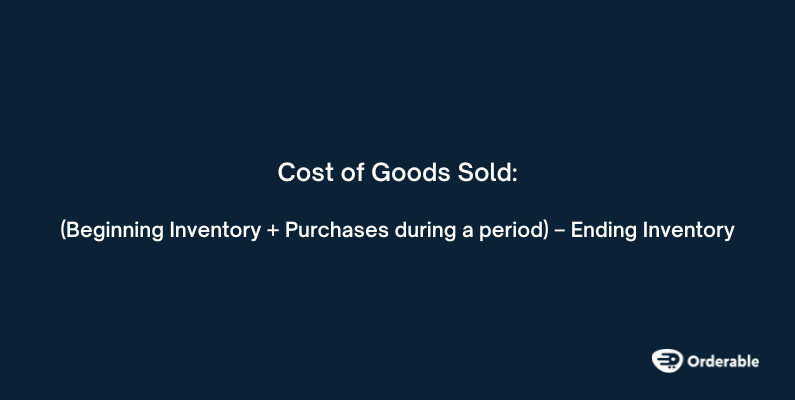
How do you calculate your Cost of Goods Sold?
Businesses can use this standard formula to calculate their COGS:
Cost of Goods Sold = (Beginning Inventory + Purchases during a period) – Ending Inventory
- Beginning inventory is the value of inventory you hold at the start of a given period (like a financial year or after a week).
- Purchases during a period. These are additional inventory costs during the same period. They are added to the beginning inventory.
- Ending inventory value. This is the total value of your inventory that isn’t sold at the end of the period. It’s subtracted from that total to calculate your COGS.
With these two metrics ready, calculating your food cost percentage becomes much easier.
What is the formula for calculating food costs?
The food cost percentage formula for determining your food cost over a specific period is this:
Food cost percentage = (Cost of Goods Sold / Total food sales) * 100%
This formula only calculates your restaurant’s total food cost percentage. But if you want to make an impact with this value, compare it to an ideal food cost percentage.
📈 Profitable restaurants typically have an ideal food cost range of 28% to 32%. It’s the industry average for many full-service and limited-service restaurants. However, there isn’t a precise target food cost range. It varies depending on the type of restaurant (like fast food, QSR, and fine dining), operating expenses, cuisine, and prevailing market conditions.
Tip: Generally, if your overall food cost percentage is higher than the ideal food cost, it suggests less room for profit and missed revenue opportunities. For instance, a higher overall food cost can limit your ability to lower menu prices. It can also force you to raise menu prices to maintain profitability despite higher food costs.
Now, let’s handle another aspect of this metric that is slightly more detailed.
How to calculate food cost per serving
It’s also best practice to know precisely how much it costs to produce one serving of a specific dish.
This calculation requires determining the actual food cost of each ingredient used in a single dish, including spices, garnishes, and more. There’s not much to the formula. It simply requires summing up the cost of all the ingredients in a dish.
Food cost per serving = Total cost of all ingredients in a dish
It’s quite a tedious process, but it can help you identify ways to reduce the costs of each food item.
But why should you spend time calculating your restaurant’s food cost percentages? What do you stand to benefit from these calculations?

Why should you calculate your food cost?
Calculating food costs requires a detailed examination of all ingredients, inventory, and food supplies utilized for preparing and serving dishes in your restaurant.
This analysis often provides a clear overview of the expenses associated with each food item. The benefits of which are enormous. Let’s have a look.
It informs your menu pricing strategy
Calculating food costs tells you how much you’re spending on food. Equipped with this knowledge, plus other restaurant costs, you can set menu prices appropriately and generate substantial revenue.
It streamlines menu optimization
Suppliers, prices, and customer habits and preferences change constantly. Calculating food cost percentages helps you adjust your menu to meet these ever-changing market demands.
For instance, by regularly analyzing your menu items and their recipe costs, you can identify the profitable dishes and those that are not. This will help you know which items to keep, modify, or remove from your menu. It can also let you try new recipes that are likely profitable.
Proper food cost control
📈 According to a report, 52% of restaurant owners cite high operating and food costs as one of their top challenges.
But how do you know if your food costs are becoming too high? One way is by regularly calculating your food cost percentage and comparing it to restaurant industry averages. It helps determine if your food costs are getting higher than usual and implement necessary changes to bring them back in line.
Otherwise, if your food costs begin to get out of control (and nothing’s done), it can negatively impact your bottom line.
Note: Food cost percentage is a valuable benchmark for assessing your restaurant’s performance against industry averages. It enables you to identify opportunities for improvement. But this should be done carefully, as other factors influence food costs, such as location, target market, etc.

It increases your profitability
Understanding your food cost percentage can help you identify profitable dishes, low-profit dishes, and more. All these are opportunities to make strategic changes that can increase your sales and profitability.
Better inventory management
Typically, restaurant food costs and inventory management are closely related. Poor inventory management often results in higher food costs and lower profit margins. On the contrary, by implementing effective inventory management, you can accurately track ingredient usage, reduce waste, and ensure the kitchen uses an accurate amount of ingredients.
It improves budgeting and planning
We’ve mentioned that calculating this metric provides a clear idea of spending on food costs for the period in question. This information is important for business owners to budget and plan effectively for their next financial period and avoid over/understocking. Not to mention, if your spending on food costs is unclear, your budget will be nothing more than a guess.
That’s it for the benefit of calculating food cost percentage. If you’re done calculating your food cost percentage and have concerns; up next, we’ll share practical tips to control and reduce your food costs.

What is the best way to track and reduce food costs in a restaurant?
It’s one thing to understand how to calculate restaurant food costs and even have some industry benchmarks you’re targeting. However, the real challenge lies in effectively bringing down your food costs.
📈 According to the National Restaurant Association, 75% of US restaurants are struggling to turn a profit specifically because of their inability to manage food costs and keep them at acceptable levels.
So, how can you reduce food costs? We have some proven practical strategies to help.
Make inventory management a priority
As a restaurant owner, implementing effective inventory management gives you control over your food stock levels.
It helps you find the right balance between having too much or too little food supplies to run your business smoothly.
Essentially, having excess stock doesn’t contribute to your business. It only uses storage, ties up valuable capital, and sometimes, spoils. Likewise, the last thing you want is scrambling for food supplies during the busiest hours.
So, how do you find the right balance?
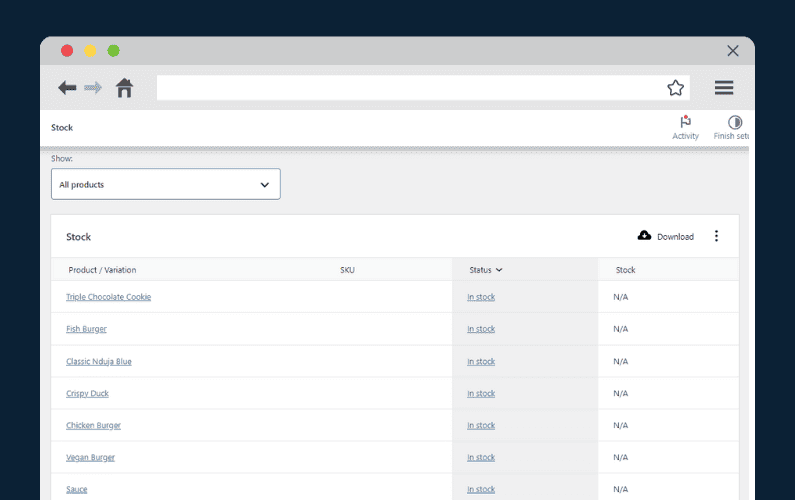
How to effectively control your food inventory levels
Installing inventory management software allows you to manage your food stock levels in three ways:
- It provides real-time tracking and accurate data on stock levels.
- It forecasts demand based on past usage patterns.
- It automates reordering when supplies run low and alerts restaurateurs to potential shortages or overstocking.
This insight can help operators reduce their food inventory by maintaining a low yet adequate amount of stock to efficiently run their business (until the next order of food supplies arrives).
Another way to maintain a lower inventory level is to conduct regular reports of your food stock. Inventory checks can be performed once a week or after a month to track what is used and identify discrepancies or wastage.
📈 But if you want to do inventory checks so well, do this once a week. Studies show that operators who do weekly inventory turnover calculations add between 2% and 10% to their bottom line.
At the same time, reducing food inventory levels by two or three days can reduce your food cost by approximately 2 to 3% or more.
Implementing both techniques will ensure your current inventory turns over quickly and ultimately lower the food cost. Food will spend less time on the shelf, and the guests will get higher-quality, fresher products. It’s a double win.
Reduce food waste
📈 Food waste is an unrecoverable cost. Studies report that 10% of food is wasted before it makes it onto a customer’s plate.
For this reason, the top causes of restaurant food waste you want to reduce and limit food wastage include:
- Spoilage. Because most food supplies are highly perishable, they can spoil due to improper handling (or improper refrigeration), storage, or packaging.
- Food spillage. It includes anything from a server dropping a food tray in the dining room during food service to a prep cook accidentally knocking over their cutting board.
- Refires. It occurs when dishes must be remade due to mistakes, such as incorrect cooking, wrong orders, or customer complaints.
By minimizing these wastes, you will deflate food costs and run a more profitable restaurant.
How to reduce food waste in restaurants
Setting up a proper restaurant inventory management system is one way to do this as we’ve seen. Other best practices you can apply to tie loose ends include:
- Track your food waste. It helps you understand what’s not selling from the menu. It gives you a clear picture of the types of food waste you’re generating and lets you identify patterns to find the root causes of that waste. Using a food waste tracker can help you with this.
Tip: Auditing food waste is essential to identify sources of inefficiency, reduce costs, and improve profitability. It helps pinpoint where waste occurs, enabling better inventory management and operational practices. Additionally, reducing food waste contributes to environmental sustainability and enhances the restaurant’s reputation for responsible practices.
- Train staff on waste reduction. Educate your team on waste reduction, emphasizing proper handling and storage to extend ingredient shelf life.
📈 If possible, discourage them from “stealing” food supplies. This is simply because according to a study, 75% of restaurant inventory shrinkage in the US comes down to employee theft.
Monitor portion control
As much as it may please customers to have leftovers to bring home, you risk creating more food waste. This can significantly inflate your food costs (and you’ll end up losing valuable profit margin on plates).
📈 In fact, research by Cornell University Food and Brand Lab indicated that, on average, diners leave 17% of their meals uneaten, and 55% of edible leftovers remain at the restaurant. The reason for this was partly because of increasing portion sizes.
Some of the best ways to control portion sizes is to:
- Standardize recipes. This means using consistent measurements, ingredients, and methods for each menu item. You can use tools like scales, measuring cups, spoons, and timers to standardize your recipes. Doing this can help you control portion sizes and calculate your food costs, inventory, and pricing more easily.
- Pre-portion your ingredients using containers, bags, or wraps before cooking and serving. Doing this allows you to prevent over-serving or under-serving your menu items.
- Use portion-control tools such as scoops, ladles, spoons, spatulas, and knives. These tools help you measure and serve the exact amount of food for each menu item and reduce food waste.
- Train your staff on how to follow your portion control standards and procedures.
- Finally, monitor and adjust your portion control through inventory sheets, waste logs, sales reports, etc.

Negotiate with suppliers
As a restaurant owner, you can easily negotiate for the best rates, favorable terms, discounts, and pricing with your food suppliers if you have a strong relationship with them.
The key here is to have open communication with suppliers!
Be clear on your expectations, like due dates of delivery, quantity, and quality of the ingredients you need. Be transparent about your concerns, such as steep prices. Make necessary suggestions for adjustments that could benefit you and your suppliers.
If they’re not willing to play ball, consider switching to another supplier or more cost-effective options.
Additionally, where storage allows, you can buy certain food supplies in bulk at a reduced cost per unit. Particularly those with a slightly longer shelf life to avoid spoilage and maintain food quality.

Optimize menu pricing
The prices you see on a menu aren’t simply random. They’re based on the cost of making that dish (and other necessary expenses), and the goal is to turn a profit. Therefore, knowing how to set menu prices effectively is a must-have skill.
But how can you determine what to charge to ensure a profit? Or, rather, optimize your menu prices so you don’t price yourself out of the local market?
Portion control, calculating food cost, and gross profit margins are three factors that can help you price your menu correctly. Instead of doing these calculations manually:
- Bring in restaurant management software. It makes it easy to track profit margins and the effects of changes in costs, ingredients, and selling prices. You can specify a selling price for a menu item, change ingredient amounts, or substitute ingredients as required. And the software will automatically calculate the cost of goods needed to prepare the dish and its profit margin.
- Review menu prices regularly based on customer demand and competitor pricing.
For instance, if you’re experiencing a higher demand for specific menu offerings, this might be an excellent ground to raise prices. Alternatively, you can price your menu items lower, the same as, or higher than your competitors depending on your market positioning, perceived value, target customer base, etc.
- Do menu engineering. It’s a technique that allows you to identify which dishes contribute most to profit and which are less popular or more costly. After that, you can adjust your menu design accordingly.
📈 In fact, menu engineering can help you grow your sales by up to 15%.

Use seasonal and local ingredients
Using seasonal and local ingredients can also translate into lower food costs and better-tasting dishes.
Why?
Seasonal produce is products harvested during a particular time of the year. Following the law of supply and demand, these products become more affordable due to their abundance.
Farmers must sell these produce before they spoil, so you won’t have to spend much getting the freshest, most nutrient-rich ingredients.
Additionally, local produce refers to crops and fresh food grown within your area. Buying locally from local farmers (or suppliers) can reduce transportation costs and support community businesses.

Use technology and automation
Finally, automate parts of your business.
By using technology to streamline restaurant operations, such as the ordering process and inventory, your business can save huge labor costs, lower your COGS, and increase revenue.
Luckily, we have the best plugin to help achieve all this with minimal effort.

Use Orderable to lower your restaurant food costs
Orderable is a WordPress plugin that adds a robust online ordering system to your restaurant.
It automates and streamlines ordering processes in two ways. It enables you to accept and fulfill online customer orders via your restaurant website. At the same time, you can create a table ordering system, allowing dine-in customers to easily order directly from their tables using their own devices.
These ordering processes are optimized efficiently using Orderable, which helps you save on labor costs, lower food costs significantly, and minimize errors.
Get Your Restaurant Business Online With Orderable
Orderable is a user-friendly WordPress plugin that adds online ordering to your restaurant website.
Add your dishes, create your online ordering menu, customize your delivery schedule, and manage orders with ease.
What you can do with Orderable and lower food costs
This plugin achieves this in the following ways. It enables you to:
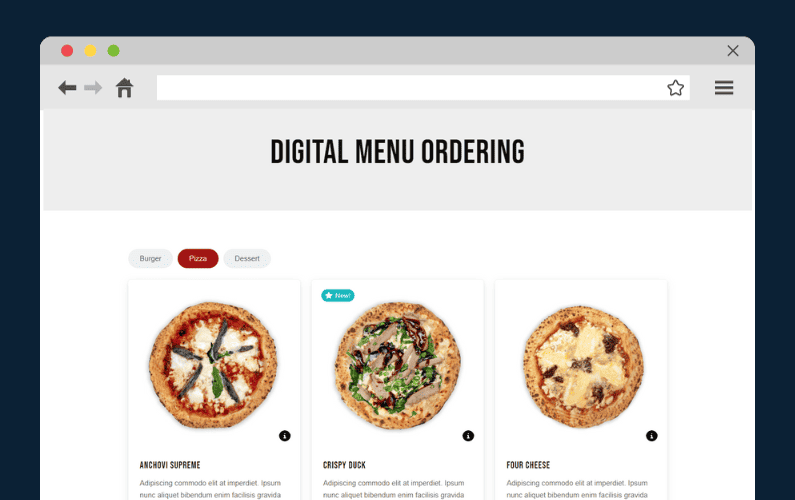
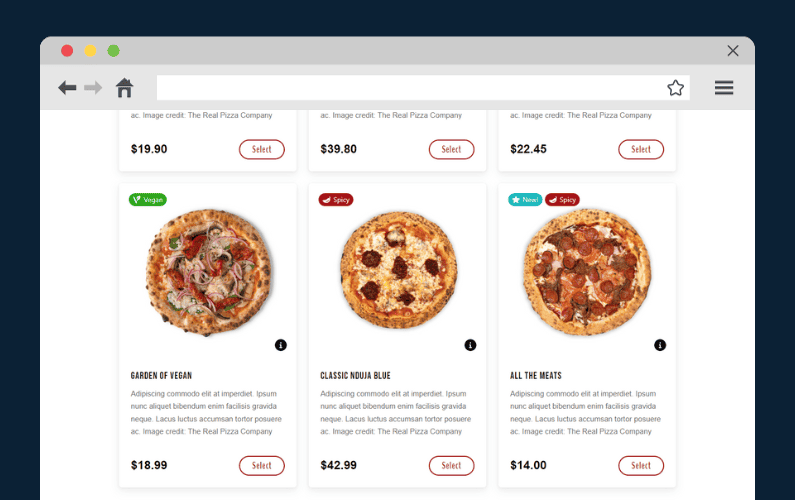
- Create simple, unique menu designs. Orderable helps with menu engineering and presentation. It allows you to categorize your dishes as highly profitable, popular, low profitability, etc., After this, you can uniquely display these food items in mobile-friendly menu layouts and clearly reflect the menu prices.
Additionally, you can add product badges, descriptions, and imagery wisely so customers can find these dishes quickly and understand your menu.
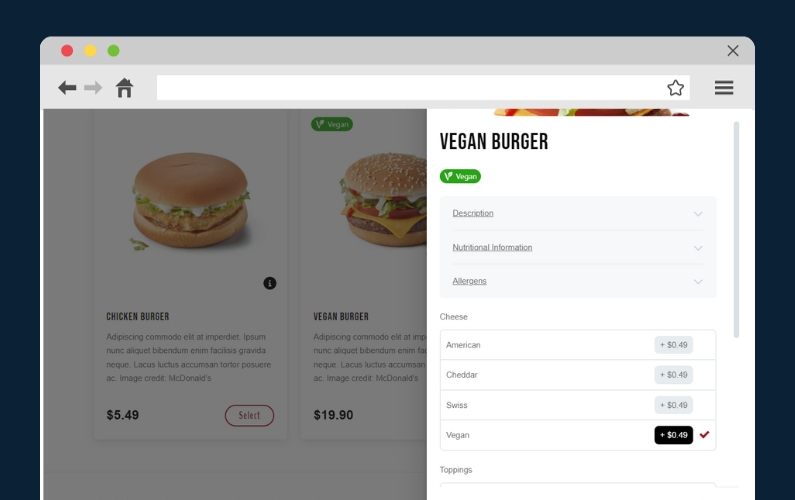
- Include product labels to add promotions, discounts, and weekly deals to gain more foot traffic, increasing your sales and revenue.
- Create menus that can be easily updated. With this plugin, it is easy to update your menu prices anytime. Also, managers can regularly update with daily specials to sell certain dishes quickly and finish inventory.
- Allow menu order customization. It allows customers to add extra cheese, appetizers, toppings, or condiments to their orders and customize. This can help manage inventory more efficiently and reduce food costs while increasing revenue.
- Add unique QR codes to your tables. This feature doesn’t only allow table ordering. It makes your QR code menu quickly accessible for your customers to order.
- Smooth integrations with existing POS system. This integration enhances order accuracy, improves inventory management, streamlines operations, and provides valuable insights that can help you lower food costs.
- Live order management screen. This screen enables the kitchen staff to see live orders as they come in real-time with full order details. In this way, it minimizes order errors that can result in food waste and refires.
So that’s how Orderable can help you lower food costs. Remember, this is an all-in-one online ordering solution that can help you create an online ordering system for takeaway, improve your restaurant’s local SEO, and so much more.
Learn how to calculate food costs today
Boosting your food sales is important, but so is reducing your restaurant’s food costs. Understanding food cost percentages can influence your decisions and positively impact pricing, profitability, purchasing, and portion sizes.
Whether it’s negotiating hard with suppliers, reducing food waste, or automating the ordering processes, look to reduce food costs in every way possible.
Orderable can help you maintain a low food cost percentage with its commission-free online ordering system. It allows you to manage your inventory more efficiently and reduce food costs while increasing revenue.
Use Orderable to update your restaurant menu and reflect any changes you’ve made after optimizing your menu prices and engineering your menu.
Get Your Restaurant Business Online With Orderable
Orderable is a user-friendly WordPress plugin that adds online ordering to your restaurant website.
Add your dishes, create your online ordering menu, customize your delivery schedule, and manage orders with ease.
Gina Lucia is our in-house Content Manager at Orderable. She writes articles, user guides, technical documentation, and creates videos on everything WooCommerce and Orderable.
Gina has been working in the WordPress/WooCommerce space since 2012 when she developed WordPress websites for clients large and small.
For the past 8 years, she’s been writing about everything WordPress and WooCommerce, becoming an expert in what makes a WooCommerce store succeed.
When not writing, Gina loves to tend to her vegetable garden, read, or travel to mainland Europe.
Don’t miss out on the latest Orderable news!
Sign up for our newsletter to receive the latest news from the blog, you’ll get pinged every week with a digest of the latest updates.
[fluentform id=”6″]

Related Articles
5 Tips for Running a Successful WooCommerce Food Store

Introducing Orderable Multi-Vendor Compatibility

How to Do SWOT Analysis for Restaurants in 2026
Get Your Restaurant Online With Orderable
The WooCommerce plugin designed to help restaurants take orders online – with no added fees!
View Pricing